Workplace Medical Readiness
Workplace AED & First Aid Readiness in Malaysia: What Good Preparation Actually Looks Like?
Prepared People. Protected Workplace.
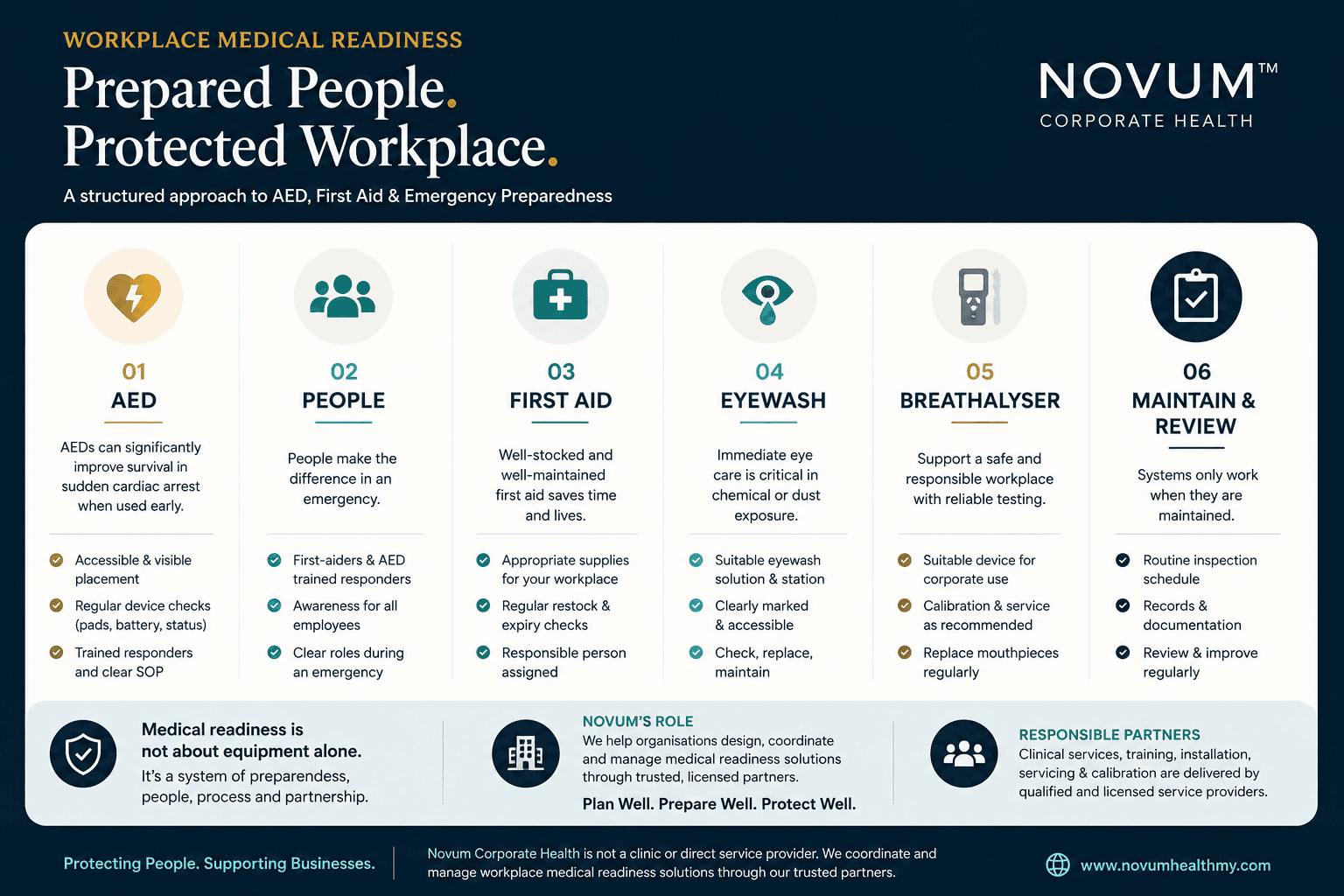
An AED on the wall and a first-aid kit in the cupboard can create the appearance of preparedness. But workplace medical readiness is not simply about owning equipment.
For employers, the more useful question is: if something happened at work tomorrow, is the organisation actually prepared to respond?
The AED Is Only One Part of the Response
Automated external defibrillators are designed to analyse a person’s heart rhythm during suspected cardiac arrest and, when appropriate, deliver a defibrillation shock. Their importance comes from one fundamental problem: cardiac arrest is time-critical.
International resuscitation guidance places early recognition, CPR and defibrillation within the established Chain of Survival. The 2025 American Heart Association guidelines continue to recognise public-access defibrillation as an important part of systems designed to improve cardiac-arrest response.
Before Buying an AED, Ask Better Questions
A useful workplace AED discussion should begin with the operating environment rather than the product catalogue. Consider where the device would be located, who knows it is there, how response training will be handled, who checks the device, and what happens after deployment or a fault.
An AED that staff cannot quickly locate or access is less useful than one integrated into a clearly understood response arrangement. Pads, batteries and other components have replacement cycles, so responsibility for routine checks should be clear.
First-Aid Kits Have the Same Problem
First-aid kits often receive attention when an office opens, moves premises or prepares for an audit. Then they sit untouched. Over time, supplies can be used without replacement, packaging can deteriorate, expiry dates can pass, and responsibility for checking the kit can become unclear.
A better approach treats the kit as a managed workplace resource: availability, ownership, condition, replenishment and context should all be considered.
Think in Terms of Medical Readiness, Not Individual Products
For HR, HSE, Facilities, Procurement and Operations teams, it can be useful to view AEDs, first-aid kits, eyewash and breathalysers as one coordinated system. Different organisations will need different combinations, but the objective should be to identify what is relevant, ensure the responsible parties are clear, and keep selected solutions operational over time.
Where Novum Fits
Novum Corporate Health supports organisations with the planning and coordination layer around workplace medical readiness. This can include clarifying organisational requirements, comparing suitable products and suppliers, coordinating quotations, reviewing relevant documentation, arranging delivery or implementation with responsible providers, and planning replacement, refill, maintenance or calibration cycles.
Product specifications, technical suitability, installation, servicing, calibration, training and other specialist responsibilities remain with the appropriate qualified supplier or service provider.
This article provides general organisational information and does not constitute medical advice, a site-specific occupational-safety assessment or statutory compliance certification. Workplace requirements should be assessed according to the organisation’s actual risks, applicable Malaysian requirements and competent professional advice where necessary.
Back to Insights